
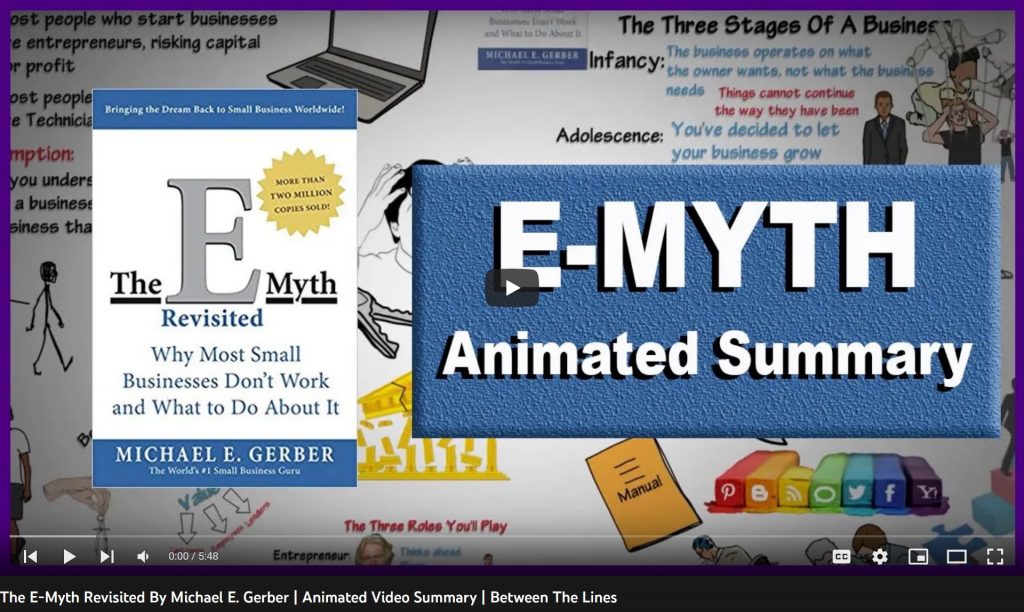
A Real Business is one where the founder has created a system so that the business can run itself without their constant presence. The book describes this as the “Franchise Prototype”. The inspiration for this comes from franchise businesses such as McDonalds, Subway, Burger King and so on, where there are manuals describing in minute detail how to run the business, so that customers will have the same experience the world over. The book does not suggest that you necessarily try and create a business to be franchised, just to treat it as if it were in some critical aspects: you need a well-documented system to run the business. Instead of running the business (fixing bicycles, writing computer programs, cooking), you need to work on the business – you need to spend time creating a business that is an entity that can operating and thrive on its own.
The “E” Myth Technician, Entrepreneur, Manager
The reason most small businesses don’t work is that they are run by a “Technician”, someone who knows how to do the technical work involved in a job, without much thought to two other, equally important roles described in the book, the “Entrepreneur” and the “Manager”. These are not separate people, but distinct elements of our personalities. In other words, while we might be biased towards one, we all have all of them, and to successfully run a small business, they must all play a role.
- The Technician is someone – a bicycle mechanic, computer programmer, cook, etc… – who is an expert in his or her craft. This often leads these people to go into business for themselves – they’re good at what they do, and they know it, so why not reap the rewards of their labor? The technician is happiest doing the work they are good at and ignoring the rest, which is, in the end, a recipe for failure.
- The Entrepreneur is the dreamer, the one who sets out to do something new, who reaches for the stars. The Entrepreneur lives in the future, thinking about what could be (rather than in the present). The Entrepreneur is often frustrated by how slow the world seems to move.
- The Manager is the detail-oriented one, who dots the i’s and crosses the t’s, the one who remembers to pay the bills, and wants a well-organized world with no surprises; a world where things happen in an orderly, predictable manner.
All of these components are necessary in the founder of a business: without the Entrepreneur, you might as well keep working for someone else as a Technician. Without any technical ability, the Entrepreneur must rely on others to get anything done, and without the organizational abilities of the Manager, the other two would probably find themselves with the electricity in the office turned off because they had other things to do than pay the bills.
The “Franchise Prototype”
If the business is to thrive, it must move beyond the founder: a business that is wholly dependant on the founder and their abilities is not really a business, but rather a very burdensome job for founder. Every time you are out sick or take a vacation or are otherwise absent, the business stops too.
The Model The model your business should follow must have these attributes:
- It provides consistent value to your customers – it can’t be great one day and lousy the next.
- It should not require brilliant people to work: certainly, you may need someone with some bicycle mechanic training if you’re running a bicycle shop; the idea is not to have people with no skills, but simply to not depend on having people of rare talent in order to work, and indeed to utilize the people with as little skill as possible. The system is what takes ordinary people and enables them to consistently do high quality work.
- Everything about the business should be documented in operations manuals.
- Everything about the model should be uniform: from the dress code to the facilities, everything should follow previously agreed upon standards.
Innovation, Quantification, Orchestration
Innovation is creativity applied to providing a product or service in a more efficient, higher quality, or more profitable way. You need to be continuously innovating in order to improve your business.
Quantification is combined with innovation to determine what actually works. If you’re not measuring it, how can you tell if a change is good or bad for business? If you spend money for a new web site, and you’re not measuring how much money is coming in through it, how can you tell if the money spent on it was worth it? You need as much data as possible – with time you’ll learn what the critical numbers are, and be able to tell how things are going by keeping an eye on them.
Orchestration is the standardization of what works: once you’ve tried and measured some particular innovation, it must become part of “standard operating procedure”. Once something has been orchestrated, it becomes a part of the business that everyone has learned and knows, not some secret recipe that lies only within the mind of the founder. This ensures consistent quality for your customers.
Aims, Objectives, Opportunities
The author explains that in order to make your business work, you must have a “Primary Aim” in life – not business, but your life. Without that, your business may come to consume you.
Your “Strategic Objective” is what you want to do with the business in order to fulfill your “Primary Aim” in life. This could be simply to sell the business on for a million dollars after 10 years, or develop a business that generates $100,000 in annual revenue without your involvement, or whatever else will allow you to live your life as you see fit. There are several important considerations, the first of which is money, and how much if it you are aiming to make.
The second thing to consider is whether a given opportunity is, as the book says, an “Opportunity Worth Pursuing”; something that can meet your financial needs, first and foremost. The key question to ask is: “does the business I have in mind alleviate a frustration experienced by a large enough group of consumers to make it worth my while?”. Another key consideration when determing what kind of business your in, is to look not at the thing you sell, but the feeling you create for your customers about your product and business. An insurance company sells you a financial instrument, but the feeling they are really selling is “peace of mind”. A flashy car is more than just a bunch of metal and plastic, it’s an image, and a feeling.
Organization Strategy
Rather than starting out and just “jumping in”, you need to determine, from the beginning, what roles your company needs, and who will fill them. The example given in the book lists 12 positions, and explains how they are divided up between two founders in a company, who must not only fill those roles, but define them so that they can, as the company grows, easily find people to place in those positions, with a well-defined structure and environment for them to thrive in. “Replace yourself with a system”, to quote the book. Each position should have a “position contract” with a list of things for which that position is accountable, and even if few people are performing multiple jobs, they should agree to and sign those contracts.
Management Strategy
The management strategy outlined is once again, a matter of having systems in place. Certainly, you need people that believe in what your company does to make those systems work, but having a system in place that doesn’t require a fantastic manager.
People Strategy The people strategy is outlined as a sort of “game” to be played
- The ‘game’ is not simply a condescending way of getting people to do what you want.
- Make sure it’s something you’d be happy to do yourself; otherwise other people wont’ want to participate either.
- Allow for rewards and victories, but don’t make it so that people can reach the ‘end’ of the game.
- Be open to change when it’s necessary.
- It is not self-perpetuating – it has to be nurtured.
- It has to make sense. Weird and arbitrary rules discourage people.
- There has to be fun involved – maybe not always, but without it, work is only dreary, something to get away from as early as possible every evening.
Marketing Strategy
You must speak to people’s unconscious minds – all the rational arguments in the world won’t win over someone whose unconscious mind has already said ‘no’. You need to learn about your key demographics, and how they think and regard not just products, but the world around them. You need to gather data about who they are. Learn about how other people market to similar demographic targets.
Systems
The book discusses three kinds of systems that are important for your business, with an eye to adopting them in order to make things ever more predictable and consistent.
- Hard systems are physical things that systematically resolve problems and free people to concentrate on meaningful work for your customers. They are things that are introduced to solve time consuming problems that do contribute to the success of the company. An example might be a tool to make cleaning a kitchen faster and more efficient.
- Soft systems are “people systems” – those practices and methods put in place to give people a framework for doing their job. These systems, in many cases, make it so that relatively less-skilled people can do high quality work, because they’re following a system created by an expert.
- Information systems are systems put in place to gather information and data about the business and its operations. With actual data, it’s possible to test different hypothesis and see which ones work the best. With data, it’s possible to know how the business is doing compared to the same metrics at an earlier date in time.
Click Below to View Video Book Review
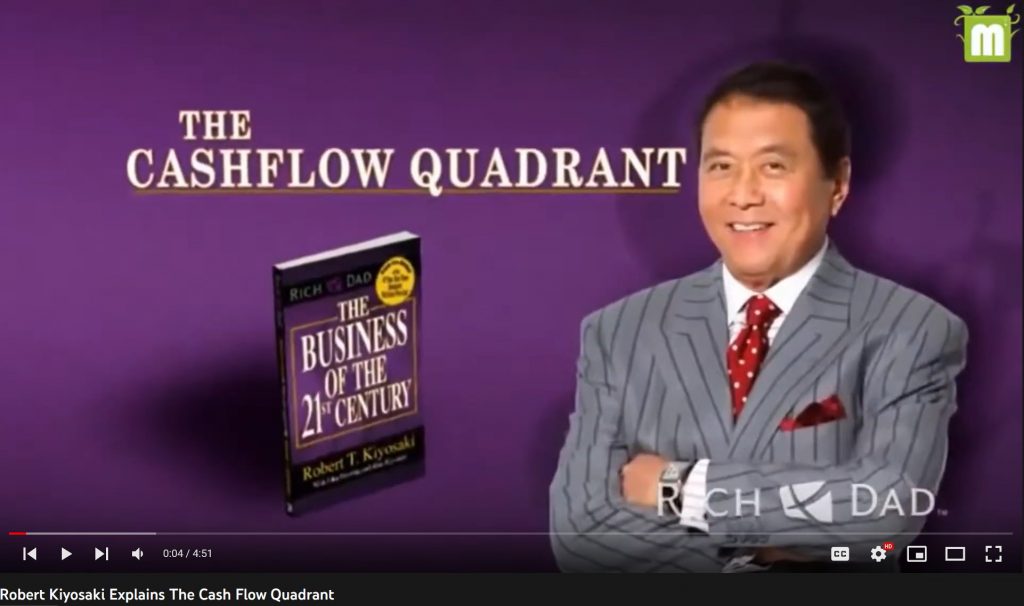
There are two books that I would recommend reading before you start investing. They are both written by Robert Kiyosaki and go hand-in-hand together. The first one is “Rich Dad, Poor Dad” and the second is “Cashflow Quadrant”.
This summary review of Cashflow Quadrant will help you to understand passive income and jump start you down the path to quit your job.
“Rich Dad, Poor Dad” changed my perspective on how to earn money and “Cashflow Quadrant” helped to solidify it. “Rich Dad Poor Dad” helped me to unlearn everything I learned from traditional education which trained me how to be an employee. I learned that the only way to really become wealthy is by having my money work for me rather than the work for my money.
In “Cashflow Quadrant” Kiyosaki teaches the four ways people make money: Employee, Sole Proprietor, Business Owner, and Investor. The biggest take away that I had from this book was that I needed to move from the left side of the quadrant to the right side of the quadrant as fast as possible if I want to become wealthy. My first attempt at the right side of the quadrant was starting a retail business.
For a couple years it was doing well, I had a manager, employees, and I just managed the entire business while they did all the work. When the economy took a downturn in 2009, my business also declined and made it very hard to profit from it. After a few more years I decided to sell the business to someone who was going to be an owner operator which is what the business needed.
At the same time I started my business, I decided to invest in rental properties. Because of the rental properties, I was able to make it through the hard times and I am continuing to invest in them today. I don’t know if I will ever do a retail business again but I do know that investment rental properties are the best way to go to build wealth.
Left side of the Cashflow Quadrant: E’s and S’s
Employee –Desires job security, a steady paycheck, no financial risk, and the benefits provided by their jobs (retirement, insurance, time off, sick days, etc.). Sense of entitlement is high with the employee and they trade hours for dollars. They also pays the highest tax rate.
Sole Proprietor – Is their own boss and not be dependent upon other people for their financial security. These include doctors, lawyers, and anyone who is self-employed. They desire independence and tend to be controlling, not trusting others to do the work as good as they can. Their income is tied directly to how much they work and if they do not work, they don’t get paid. They basically “own” a job.
Right side of the Cashflow Quadrant: B’s and I’s
Business Owner – Starts businesses and hires employees to delegate as much as possible. They work “on” the business and find competent people to work “in” the business. They desire to create a business that can run on its own without them. They focus on creating systems for the business to make money without them.
Investor –Looks for ways to make their money, as well as the money of others work for them. They desire to work less so they can spend their time however they want while not being tied down to a job. Escapes high taxes by deferring their taxes to a future date or utilizes the IRS rules to pay the lowest tax rate of all the other groups. They receive 70% of their income from investments and less than 30% from a job.
If you want to be rich, you should jump to the B and I side of the quadrant ASAP
The rich focus the majority of their efforts on the Business and Investor side of the Cashflow Quadrant because that is where the real wealth and money is. The good news is, if you are starting in the Employee category you can move to any of the other quadrants at any given time. It IS entirely possible to move from E to I very quickly.
- Every dollar you invest is another employee working for who makes more employees who do the same
- Live wherever they want
- Do whatever they want
- Buy whatever they want
- Income comes in the mail whether they work 60 hours a week or 1
- Complete financial freedom
- Pay lowest of all tax rates
- Defer taxes to a future date with IRS 1031 exchanges almost indefinitely
- No liability because corporations own everything
- Complete control over everything because they own the corporations
- Not dependent on anyone for their lifestyle or freedom
- As soon as their income from investments surpass their wages they retire
- Not dependent on Social Security, 401K, IRA, Pension, etc.
Get your copy of Rich Dad’s Cashflow Quadrant available at Amazon.com.


Click Below to view Video Book Review

The 10x Rule Book Notes: This book can potentially be life changing.
Here are the top things I learned (or was reminded of in a positive way):
1. Instead of blaming the economy for down sales, blame your activity level for being too low
It’s easy to get in the mindset that the problem is the market or the economy. He makes a
great case that the problem is the activity of you and/or the employees in your company.
2. Become omnipresent
He has a chapter about omnipresence. This is a GREAT mindset for marketing….become
omnipresent in your market.
3. Seek to dominate your market instead of being competitive.
Being competitive is the wrong target. This is a great point and changes your mindset
totally.
4. We consistently underestimate the activity level required to get a result
The problem isn’t laziness or anything else. It’s simply that we underestimate
the activity level required to launch a new product, make sales or create a
successful marketing funnel.
5. 10x thinking + 10x action
This isn’t about thinking only (like Think and Grow Rich) or action only.
Action without the right thought behind it spins your wheels.
6. Set your goal to be 10x greater than you think you need
Expand your thinking. I like this idea. It changes the activities you
plan to reach your goal.
7. Plan to take 10x the actions you think you need
Massive action is actually the level of action that creates new problems. Until you create problems, you’re not truly operating at the forth stage of action.
8. Average is a failing formula
The addiction to average can kill the possibility of making your dreams a reality. Operating at average levels doesn’t work in any area of life. Most businesses fail because they are unable to sell their ideas, products, and services at prices high enough to sustain the company and fund its activities. The company isn’t able to collect revenue in quantities great enough because the people with whom the company has been built – employees, customers, and vendors – also take only average amounts of action.
9. 10X Goals
Here is what Grant describes as the method of setting 10X goals:
§ Set 10X targets
§ Align them with your other purposes
§ Write them down everyday: when you wake up and before you go to sleep.
We have been warned against setting goals “too high”. The reality of that if you start small, you are probably going to go small. Many people bail out of projects when they experience any kind of resistance; their goals are not big enough. Grant talks about the importance of aligning goals to other goals to fuel will power, energy and dreams. Grant talks about never set small, attainable realistic goals, instead set unrealistic goals.
10. Competition is for sisses
Grant talks about never make it your goal to compete. Instead, do everything you can to dominate your sector. This means doing things that your competitor refuses to do.
11. Breaking out of the middle class
Grant warns about the middle class being the most suppressed, restricted, and confused socioeconomic demographic in the world. Those who desire to be a part of this is compelled to think and act in a certain way where “just enough” is good enough and a reward. The idea that one would only have enough to be “comfortable” or “adequately satisfied” is a concept has been sold by politicians, media, educational system to inspire entire population “to settle” instead of striving for abundance.
12. Obsession isn’t a disease. It’s a gift.
Most people make only enough effort for it to feel like work, whereas the most successful follow up every action with an obsession to see it through to a reward. It is vital to go for a bigger goal if you wish to see 10X results.
13. Go “All In” And Overcommit”
Grant talks about overcommitting your energy, resources, creativity, and persistence. Know that you are “all in” on that particular activity, everytime you take action everyday you are in business.
14. Expand, Never Contract
Contracting is a form of retreating, it violates the concept of the 10X rule. You have to take massive action.
15. Burn the place down
Once you take the 10X actions, don’t stop, keep the momentum going. Grant talks about the importance of staying committed.
16. Fear is the great indicator
Fear means you are doing what’s needed to move in the right direction. Without “fear”, it means you are only doing what’s comfortable for you now.
17. The myth of time management
Grant talks about jotting down your time-wasting activities. Most people work just enough to make it feel like work, whereas successful people work at a pace that gets satisfying results that work is a reward.
18. Criticism is sign of success
Criticism precedes admiration, goes hand in hand with success.
19. Customer satisfaction is the wrong target
Customer satisfaction is the wrong target, increasing customers is the right target. You will first have to get the customer first and satisfy him/her later. That means, you have to increase sale.
Top Videos
| 1. SETC Business Intro (7min) | |
| http://FFCRA.pro | |
| 2. Your idecide Videos SETC, ERC, Stream PC | |
| 3. The 401k/IRA Tax Free Compilation (10 min) | |
| https://mikeceo.wistia.com/ |
|
| 4. The 401k/IRA Tax Free Alternative (6 min) | |
| https://vimeo.com/740920020 | |
|
5. Tony Robbins: The Secret of the 50 Richest and Most Successful People in the World (4 min)
|
|
| https://vimeo.com/716009099 | |
| 6. Longevity: The Biggest Threat to Your Nest Egg (7 min) | |
| https://vimeo.com/282596962 | |
| 7. How Money Works Media Tour (2 min) | |
| https://mikeceo.wistia.com/ |
|
| 8. How Money Works Rule of 72 Download Free Chapter | |
https://www.youtube.com/
https://www.youtube.com/watch?
3. Silent Yachts
https://www.youtube.com/
4. Leisure Travel Van 2021 Wonder RL
https://www.youtube.com/
5. Dream Home Poway CA
https://www.youtube.com/
6. Grand Canyon Rafting Trip *Most Popular * Motorized Raft Trip With Advantage Grand Canyon
https://www.youtube.com/
Top 5 Success Videos
1. Tom Brady
https://www.youtube.com/
2. Steve Jobs
https://www.youtube.com/
3. Ronald Regan
https://www.youtube.com/
4. Miracle on Ice
https://www.youtube.com/
5. Rocky Balboa Talk to Son
https://www.youtube.com/
The next 10 minutes you spend reading this might be one of the top 10 most life-changing events of your life.
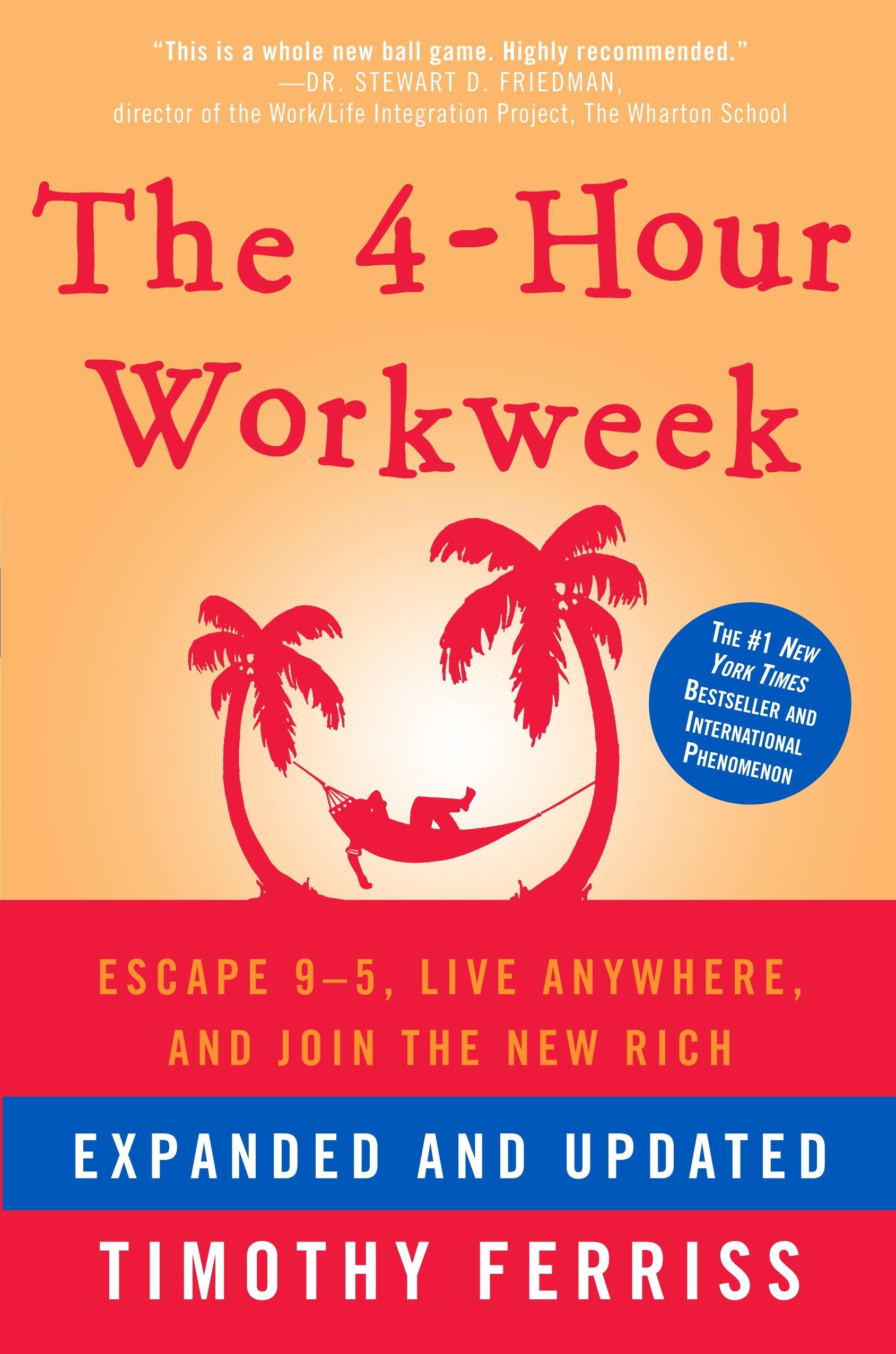
Reading the book was one of the top 10 most life-changing incidents of mine. The 4-Hour Workweek is the manifesto of a new and better worldview, a profoundly transformational shift that is the antithesis to some of modern society’s most entrenched and pervasive assumptions about the way life is and will be.
This might be the most inspiring book I’ve ever read – in the truest sense of the word – because the author presents a new possibility for the reality of life, and actually follows it up with pragmatic, step-by-step instructions. Tim Ferriss isn’t just an author with some good ideas; he lived out every step in the book. The advice he’s able to give from going through that experience was enough to change not only my life, but others, as evidenced by 1.3 million copies sold and seven consecutive years on the New York Times bestseller list. He’s not a one-trick pony, either – his other two books have also been bestsellers, and his blog and podcast have both ranked #1 in the world in their categories. Tim has also been an investor or advisor for Facebook, Twitter, Uber, Evernote, Shopify, Duolingo, and Alibaba, among others, which would suggest he knows a thing or two about making success happen.
First and Foremost
To leverage the techniques in this book, you don’t have to quit your job, or be a risk-taker, young, or single. You don’t need to be born rich, or graduate from an Ivy League school. Anyone can escape the “deferred-life plan,” which the author labels as a “fragile collection of socially reinforced illusions.” His greatest fear is “a tolerable and comfortable existence doing something unfulfilling.”
Real wealth comes from time and mobility, as well as money, and those who have learned to build these dual additional currencies have become what Tim calls the “New Rich.” This is one of the underlying truths of the book: people don’t want to be millionaires; they want to experience what they think only millions can buy. This book is about having a lifestyle of complete freedom without having a million dollars, by using the currencies of time and mobility.
Tim clarifies that you probably won’t be able to replicate every single thing he recommends, but you can use the same principles to get the same results. Instead of passively accepting things for the way they are, be a dealmaker. (See Chapter 5 in the summary of Rich Dad, Poor Dad for more on taking that advice to heart.)
The framework for most of this book is structured under the acronym “DEAL”:
Definition: Replace self-defeating assumptions.
Elimination: Forget time management; learn to ignore the unimportant. (provides time)
Automation: Learn to put cash flow on autopilot. (provides income)
Liberation: Create freedom of location. (provides mobility)
Tim wraps up the intro by giving a pretty detailed chronology of his life, which I respect tremendously for its boldness. Almost without exception, people who succeed leave out the details of how they got there, leaving you to wonder if their methods just got them in trouble until they just got lucky, or if they really have a repeatable formula. People like to create a narrative of consistent upward progress because that is the version of reality that the world expects. True to the stated principle of the book, Tim shares the up-and-down journey and “lucky” breaks.
Step I: D is for Definition
Chapter 1: Cautions and Comparisons: How to Burn $1,000,000 a Night
Tim begins expounding on his “New Rich” classification by specifying precisely what it is not – spending your life working to buy things you don’t need, like the guy who is rich enough to drop $1,000,000 in a night at Vegas, but never liked a single one of the businesses he started. The author then provides a number of additional examples of the contrast. Here are a few:
Deferrer: To work when you want to.
New Rich: To have others work for you.
Deferrer: To retire early and young.
New Rich: To distribute recovery periods and adventures (mini-retirements) throughout life on a regular basis and recognize that inactivity is not the goal. Doing that which excites you is.
Referrer: To reach the big pay-off, whether IPO, acquisition, retirement, or other pot of gold.
New Rich: To think big but ensure payday comes every day: cash flow first, big payday second.
Tim sees being financially rich and being able to live like a millionaire as two profoundly different things. Why? Money is multiplied in practical (or “lifestyle”) value if you can control what you do, when you do it, where you do it, and with whom you do it. What we want isn’t money; it’s the power to do what we want with our lives.
Chapter 2: Rules that Change the Rules: Everything Popular Is Wrong
If everyone is defining a problem or trying to solve it the same way and the results aren’t satisfactory, ask, “What if I did the opposite?” As an example, the author talks about how in his first sales job, he discovered that the primary barrier to setting up a meeting with potential clients was the gatekeepers (secretaries, etc.). He started making all his calls only from 8:00 – 8:30 and 6:00 – 6:30, which netted him twice the number of meetings than the people who made calls all day long from 9 – 5.
In this chapter, Tim presents ten ways that you need to redefine and solve life in order to leverage this principle.
- Retirement is worst-case scenario insurance. The whole concept of retirement is predicated on the assumption that you dislike what you’re doing during the most physically capable years of your life, which is a terrible and completely unacceptable reality. To be honest, building up enough capital to sustain a retirement above the poverty level is a mathematical impossibility for most people, given the realities of today’s market. Only incredibly ambitious and hard-working individuals could ever reach such a goal, and if you’re that type, are you really going to want to sit around and do nothing? You’ll probably want to get another job – so why did you wait all those years?
- Interest and energy are cyclical. The key to thriving is alternating periods of work and rest, and that principle holds true at the career level. By distributing “mini-retirements” throughout life, you not only have a more enjoyable life, but you are also more productive when you work.
- Less is not laziness. Our culture tends to reward personal sacrifice over personal effectiveness, but the New Rich measure their contribution in results, not time. Laziness isn’t working less; laziness is letting circumstances define your life for you, or “passing through life like a spectator from an office window.”
- The timing is never right. Forget the pro/con list; whatever it is that you want to do someday, just do it now.
- Ask for forgiveness, not permission. People will deny things on an emotional basis that they’ll actually accept after you’ve already done it. As long as any potential damage is minimal or reversible, don’t give anyone the chance to say no; just do it, and you can ask for forgiveness later if necessary.
- Emphasize strengths, don’t fix weaknesses. Enhancing your strengths often provides a multiplier effect, while trying to fix weaknesses typically leads to only incremental improvement.
- Things in excess become their opposite. This is true of time as well as possessions. The point of this book is not to create excess idle time, but to allow you to use your time to do what you want to do rather than what you are obligated to do.
- Money alone is not the solution. Adding more money isn’t the answer as often as we think it is. We delude ourselves into thinking that we need more, and busy ourselves trying to make more, thereby avoiding the real problem.
- Relative income is more important than absolute income. Relative income is a measure of both time and money; for example, the person working 10 hours a week and making $10,000 is richer than the person working 80 hours a week and making $100,000.
- Distress is bad, eustress is good. Eustress is stress that helps you grow. Embrace good stress instead of avoiding stress altogether.
Chapter 3: Dodging Bullets: Fear-Setting and Escaping Paralysis
Cut through the ambiguous anxiety about doing what you want to do by naming your worst nightmare, literally and specifically: what’s the worst that could happen? Then think of simple steps you could take to recover if it did happen. Define the worst case scenario on a scale of 1 – 10, then do the same for the potential benefit. You might find that you’re avoiding taking action that could have a permanent positive effect of 9 because of a possible temporary effect of 3. Now compare that to the risk of being stuck in an office for the next 40 years. What is it really costing you to postpone action?
Chapter 4: System Reset: Being Unreasonable and Unambiguous
Because most people are convinced they can only accomplish mediocre things, the competition for mediocre goals is actually more intense than the competition for incredible things. Perhaps this is also partly due to motivation – we will try much harder for a dream worth dreaming. Rather than asking yourself, “What do I want,” or “What are my goals,” try, “What excites me?”
You have to define that alternate reality to replace what you’re doing now. Otherwise, you’re stuck with the vague, “I’ll make X dollars and then I can do what I want.” Define what you want! The author introduces the term “dreamlining”: applying a timeline to your dreams to make the shift from ambiguous wants to defined steps. (This is the same technique championed by Tony Robbins in Section 3 of Money: Master the Game.) The goal has to be unrealistic to be effective, and it has to focus on activities to replace the work you’re doing now.
- Create a 6-month and 12-month timeline, and for each one write down five things you dream of having, five things you dream of being, and five things you dream of doing. Then convert each “being” into a “doing” to make it more defined. If you need a more defined framework, write down one place to visit, one memory of a lifetime, one thing you’d love to do every day, one thing you’d love to do every week, and one thing you’ve always wanted to learn. You can download Tim’s dreamline worksheet here.
- Out of all 15 for each timeline, circle the four that would change it all.
- Research and calculate the monthly cost of each of those four. Think in terms of monthly cash flow, not total cost. (a $260k Lamborghini can be leased for less than $3k/month.)
- Add up all the expenses, multiply by 1.3 (cushion for savings), then divide by 30 to get your target daily income.
- Write down three first steps for each of the four dreams in your six-month timeline and take the first step now. (“Now” as in “leave this webpage immediately, go do those four things, then come back.”) Do the second four steps by 11:00 a.m. tomorrow, and the last four by 11:00 a.m. the day after. The steps should be doable enough that you can make this happen.
Step II: E is for Elimination
Chapter 5: The End of Time Management: Illusions and Italians
After defining what you want to do with your time, you have to free that time (without taking an income penalty). The approach to time management that most people take is the wrong one: trying to fill every moment with productivity. Because the expectation in an office environment is constant motion, not productivity, you must remove yourself from that environment. As an employee you’ll need to liberate yourself with a remote working arrangement before you can automate. If you’re an entrepreneur, the roadblock is your business, not your employer, so you’ll be going in the reverse order – automating in order to liberate yourself.
Tim then introduces the Paretto principle, famously observed by Italian economist Vilfredo Pareto: in any field of endeavor, 80% of results come from 20% of actions. Ask yourself the following questions:
- What 20% of sources are causing 80% of my problems and unhappiness?
- What 20% of sources are resulting in 80% of my desired outcomes and happiness?
You’ll have to spend some time to think about these questions, but if you think you can’t answer them clearly, you haven’t thought about them enough. There are no exceptions to the Paretto principle.
Tia’s example comes from when he realized that five of his customers were bringing in 95% of his revenue. Two of those five were horrible, and the three others never caused any problems. So, Tim stopped putting any effort into the 120 other customers, and confronted the two problem customers. One left; one shaped up. Tim then focused all his effort on finding customers like the top three, and in a month doubled his income and cut his hours from 80 to 15.
If you’re going to join the New Rich, you need to make the fundamental mentality shift that “being busy is a form of laziness – lazy thinking and indiscriminate action… lack of time is actually lack of priorities.”
The other half of time management is known as Parkinson’s Law: “A task will swell in (perceived) importance and complexity in relation to the time allotted for its completion.” These two laws are synergistic: only do the 20% to shorten time, and shorten time so you focus on the 20%.
Chapter 6: The Low-Information Diet: Cultivating Selective Ignorance
Never read the news. If it’s actually important, people will be talking about it and you’ll find out. Tim does email once a week for an hour, which might not be possible for those of us stuck in the 9 – 5. But the point is that if you remove yourself as the bottleneck, the problems disappear.
As a mental reset, he also recommends taking five days to completely eliminate television (except for one hour of pleasure viewing), reading books (except for one hour of fiction), and web surfing (unless necessary for work).
To wrap up the chapter, Tim gives some other tips and tricks, the most important of which is practicing the art of nonfinishing. Most of us are in the habit of automatically finishing whatever we start, but if you feel an article, movie, meal, or anything else is wasting your time, stop. It will take practice to break this ingrained and wasteful habit.
Chapter 7: Interrupting Interruption and the Art of Refusal
Tim tells the story of how in college whenever he didn’t get an “A” on a paper or non-multiple choice test, he would go to the grader’s office with 2 – 3 hours of questions. With this method he learned exactly how the professor’s mind worked, but more importantly, the professor would never again give him anything less than an “A” unless there was a very good reason – otherwise they knew they would face another 2 – 3 hour visit.
The lesson is to be difficult when it counts – develop the reputation of being assertive so you fight your fight once, up front, instead of many times later. In the context of this book, Tim identifies three main categories:
- Time wasters: unimportant email, phone calls, meetings, etc. Turn off the notification on your email as well as the auto send/receive, and check email only twice per day, at noon and 4:00. Tim recommends you set an autoresponder letting people know that due to high workload you are checking email only at those times. Include a number people can call if they have an urgent need. Remember – ask for forgiveness, not permission. You could speak to your boss beforehand and propose you try the approach for a few days, citing constant interruptions and a pending deadline. Then move to checking email only once a day as soon as possible.
Do the same for your phone communication – put your office phone on silent and always let it go to voicemail. In your voicemail recording, give callers that second number they can call if they have an urgent need. When someone does call the urgent number, get to the point of the call immediately. For example:
You: “Hi, this is John.”
Caller: “Hi John, this is Jane.”
You: “Hi Jane, I’m right in the middle of something/I have a call in just a minute/I’m about to go to a meeting. How can I help?”
The last step is to eliminate meetings. Tim gives a few tips for doing so:
- Your communication preference should be first email, then phone, then meetings. Try to always steer people up the chain (e.g., from meeting to email by asking the person who has requested the meeting to send you an agenda first).
- Respond to voicemail with email whenever possible. Propose “if-then” solutions that take you out of the problem-solving process.
- Meetings should never be held to define a problem, only to make decisions about a problem that is already defined. Use the agenda trick, and you’ll find you can often avoid the meeting by answering the question via email.
- If meetings are necessary, define the end time in advance. You can site an important commitment you have soon after the meeting.
- Use the phone efficiency technique when people drop by your work station – let the intruder know you’re in the middle of something, but also insist that they go ahead and tell you what they want so you get the quick summary instead of having them bother you again later.
- Use the “Puppy Dog Close” to manage up and across to eliminate wasteful meetings. When the pet store salesman says, “Just take the puppy home and try him out, and you can bring him back tomorrow if you want,” it’s much more likely the sale will be made, and highly unlikely the puppy will be brought back. Try, “I’d really like to go to the meeting, but am swamped today. Can I sit out just for today and catch up with X afterward?”
- Time consumers: things that must be done but often interrupt high-level work – customer service, financial reporting, personal errands, etc. The best practice for time consumers is simple: batching. By stretching the time periods between doing these kinds of tasks then doing them all at once, you eliminate setup and switching time, among other efficiencies.
- Empowerment failures: when someone needs approval to make something insignificant happen. To avoid these, establish a clear (ideally quantitative) threshold up to which your delegates have authority to make decisions on your behalf. Adjust the threshold based on results.
This works the other way as well – if you’re being micromanaged, put together some rules that would give you freedom to spend less time getting approval from your boss. Tell your boss something like, “I know you’re busy, and I hate to always be interrupting you. I’ve been doing some reading and have some ideas about how I can be more productive. Can we try out these guidelines for a day/week?”
A good way to sum up this chapter is to always let your default response for any request be, “No.”
Step III: A is for Automation
Chapter 8: Outsourcing Life: Off-loading the Rest and a Taste of Geoarbitrage
A key part of becoming a member of the New Rich is to build systems to replace yourself, and an easy way to begin doing so is to hire a virtual assistant (VA) – someone in a low-cost geographic location who can save you time doing menial tasks. Tim mentions Brickwork and Your Man in India. Both are still in operation in 2015, but Your Man in India seems to have shifted its focus away from VAs. You’ll have to submit a request on Brickwork’s website for their current rates, but as of 2015 it will cost you $11 -$15 an hour for a VA to take care of personal errands, scheduling appointments, etc. (VAs with specific skills like business research or SEO may cost up to $22.) eLance.com is also mentioned later, and services like Fiverr have also become available since Tim wrote the book. However, going with a VA company rather than a single VA gives you a backup in case one person becomes unavailable. Try out a few VAs, and see which one you like the most.
First try to eliminate, and then try to automate. Only delegate what remains; otherwise you’ll be wasting your time and money. Additionally, make sure each task is both time-consuming and well-defined – otherwise, delegation might not be the most effective option.
The biggest objection people have is the expense, but Tim’s reply to that concern is to consider what an hour of your time is worth. If you could pay $40 each week to have Friday off, wouldn’t you do it? Paying $40 for a VA that saves you eight hours of work throughout each week is essentially the same thing.
The second objection is security, and the author goes into detail about how your personal information is much more secure with these VA firms than it is on your own computer. Use common sense, and you’ll be fine.
Here are a few more useful tips:
1) Request someone who has excellent English and make it clear that phone calls will be required.
2) Don’t just accept the first person the firm provides. Shop around to get a great VA.
3) Give instructions at the 2nd grade reading level. If you can’t do that, you’re probably not being sufficiently precise. Calibrate as necessary once you’ve assessed the VA’s abilities.
4) Request that a status update be provided after the first couple hours to ensure that things are on track.
5) Set the deadline at less than 72 hours.
6) Always clarify the relative priority of tasks or portions of tasks.
Chapter 9: Income Autopilot I: Finding the Muse
Now that you’ve made some room in your schedule, it’s time to find your muse, which the author defines as a product-based business that costs less than $500 to test and after a month’s time will require less than one day per week to manage.
Step 1: Pick an affordably reachable niche market. Find a market first by defining your customers, and then design your product around them. It becomes much easier if you’re a member of that target market yourself.
Step 2: Brainstorm (do not invest in) products. Here are your brainstorming constraints:
- The benefit of your product should be explainable in one sentence or phrase.
- Your product should sell for between $50 – $200, which is the sweet spot to be able to sell fewer units, create higher profit margins, and attract lower-maintenance customers – but not so expensive that customers want to speak with you before buying.
- Your product should also take less than four weeks to manufacture in order to keep costs low and easily adapt to demand. One to two weeks is ideal.
- Your product should be fully explainable in an online FAQ.
This isn’t a formula for a good business; rather, it is a set of constraints suitable to the specific type of lifestyle business that qualifies as a muse.
If you read the top three books on a given subject, you’ll know more about the subject than 80% of the relevant population, thereby qualifying you as an expert. Simply take a general subject and summarize it in a way that is specific to the needs of your niche market. For example, if you’re a real estate broker and realize that you’d like a simple but good-looking website to promote your services, read the three top selling books on home page design, and create a CD, ebook, guide, etc. to communicate the key points as they relate to a real estate broker. Bonus tip: To crank up the expert factor, consider finding experts to interview and sell the accumulation of their advice.
The person with the highest credibility will sell the most, not the person who knows the most about the subject. Fortunately, it’s very easy to establish credibility. In less than a month, your bio could read like this: “Top relationship expert who, as featured in Glamour and other national media, has counseled executives at Fortune 500 companies on how to improve their relationships in 24 hours or less.” Here’s how:
1) Join two or three related trade associations with official-sounding names.
2) Read the three top-selling books on the topic and write a one-page summary of each.
3) Go to the closest well-known university, put up posters advertising a free seminar on the subject, and give the seminar using the summaries you’ve written.
4) Call up a local branch of a well-known company and tell them you’ve done the seminars at the university and that you’re a member of the trade associations. Explain that you’re trying to gain speaking experience outside of the academic setting.
5) Leverage your trade association membership and speaking experience to get an article published for a trade magazine. One option is to interview a known expert for the article.
6) Join ProfNet or ExpertClick, services journalists use to find expert quotes for their articles. Use the credibility you’ve gained from the previous steps, and it’s actually pretty easy to be quoted in well-known media.
Chapter 11: MBA – Management by Absence
Once you have a profitable formula, the challenge is to remove yourself from the equation. Here are the two primary guidelines:
1) Learn how to do something yourself, then contract outsourcing companies that specialize in that function, not freelancers. This gives you a redundancy plan so you’re not depending on one person.
2) Make sure all outsourcers are able to communicate among themselves, and give them written authority to make inexpensive decisions on your behalf.
Tim recommends you implement outsourcing in three phases:
Phase I: 0 – 50 units of product sold. Start by doing everything yourself so you can learn from customers about what they want, what their concerns are, and what isn’t sufficiently clear on your website.
Phase II: >10 units sold per week. Find a fulfillment company (just Google “fulfillment services”) who will agree not to charge you setup fees or monthly minimums (usually the smaller firms), and who will respond to inquiries from customers. Give them the list of responses you’ve collected from dealing with customer service yourself. After paying promptly for a month, ask for net 30 payment terms.
Phase III: >20 units sold per week. Decide upon an end-to-end fulfillment company, and ask for references to call centers and credit card processors they’ve worked with. Set up an account with the credit card processor first, then engage the new fulfillment company (necessary so the fulfillment house can also handle refunds and declined cards for you). If you need a call center, call the actual number of each one a few different times to test the wait times and personnel quality.
An important part of setting up your “muse” correctly to reduce service overhead is what Tim refers to as the art of “undecision.”
1) Offer only one or two product options.
2) Offer only one shipping option, as long as it’s not overnight or expedited. Otherwise, you’re inviting anxious phone calls.
3) Only take orders online, never by phone.
4) Don’t offer international shipping.
If you’re worried you’ll lose customers by doing these things, you’re right – that’s the point. Avoid dealing with problem customers (i.e., time consumers) by preventing them from ordering in the first place.
Step IV: L is for Liberation
Chapter 12: Disappearing Act: How to Escape the Office
Tim offers a five-step process to convince your employer to let you do your job out of the office:
Step 1: Increase investment. Get your employer to first invest in you to increase their cost if you leave. For example, ask if the firm has any additional trainings available to employees and take them.
Step 2: Prove increased output offsite. Call off sick for two days in the middle of the week, double your work output on both days, and make sure to demonstrate and record it with an email trail or otherwise. If you have to be on your computer at work, try GoToMyPC remote access software.
Step 3: Prepare the quantifiable business benefit. You need to position remote working as a business benefit, not a personal perk. Bill more client time, complete more projects, or otherwise demonstrate quantified improvement. Explain the increased productivity as less time commuting and fewer distractions.
Step 4: Propose a revocable trial period. Informally mention to your boss how you were sick those two days and didn’t expect to get anything done, but were actually twice as productive. Ask if you could try working from home Monday and Tuesday for the next two weeks as a trial that your boss can veto at any time. Make sure to mention that you’ll of course come to the office for any meetings or anything else that comes up. “So what do you think? Test it out starting next Monday and see how much more I get done?” When your boss objects, acknowledge his concerns and propose working from home only one day a week instead.
Step 5: Expand remote time. Continue to kill it on your work-from-home days and slightly drop your in-office performance to heighten the contrast. Ask for another trial period with an extra two days at home, dropping down to one extra day if necessary. After your boss has gotten used to this, ask for a full-time remote trial of two weeks as you visit relatives out of state or some other understandable reason to need to be away. (Bonus tip: schedule vacation for a time that you know will be busy at work, then once the time comes and people are panicking, be the hero by offering to work the whole time remotely instead.)
Chapter 13: Beyond Repair: Killing Your Job
If you can’t get to a satisfactory level of remote working at your job – just quit (as long as you’re more likely to find what you want somewhere else other than your current job). Tim counters the four usual objections to doing so:
Objection #1: Quitting is permanent. Go back to the exercise in Chapter 3, and you’ll quickly discover that it’s entirely possible to get right back on the same track if you change your mind.
Objection #2: I won’t be able to pay the bills. First of all, don’t quit without having another job lined up if you don’t have another source of cash. Secondly, there are always options to lower expenses. Go through all your monthly expenses and ask yourself, “If I had to eliminate this because I needed an extra kidney, how would I do it?”
Objection #3: Health insurance and retirement accounts disappear if I quit. The health insurance situation in the U.S. is different now from when Tim wrote this book, but you can still probably get insurance for about the same price. In addition to the government’s insurance exchanges, there are plenty of private insurance exchanges. You might even qualify for some discounts through a professional association or other group. As for retirement, it’s easy to transfer your 401(k).
Objection #4: It will ruin my resume. If you’re quitting your job in the spirit of this book, you’re doing it in order to do something interesting. The period after you quit is going to be the most interesting item on your resume (if you ever need one again), and the one thing that will make you stand out the most and land interviews.
Chapter 14: Mini-retirements: Embracing the Mobile Lifestyle
In this chapter, Tim attacks what he calls “one of the biggest self-deceptions of the modern age: extended world travel as the domain of the ultrarich.” People work their whole lives, hoping to save enough money to retire to a tropical beach house. The really ambitious seek out high-stress, high-paying careers in law, finance, etc., telling themselves they’ll work nonstop for 15, 20, 25 years in order to save up a couple million to finance their early retirement of proverbial motorcycle rides across China.
Tim has spent less than $3,000 each for three common “deferred dreams”: living large in Thailand, sailing across the Caribbean, and even riding that motorcycle across China.
He’s also paid $250 for five days on a private tropical island with three local fisherman who caught and cooked all his food and took him to all the best hidden diving spots in Panama, and $150 for a three-day private plane charter over the beautiful Mendoza vineyards and snow-capped Andes mountains of Argentina. You can easily blow that kind of money in a weekend or two of “nonsense and throwaway forget-the-week behavior” in most U.S. cities.
Tim actually suggests much more than one-to-three-week life-
This alternate reality may seem strange to you, but it’s not just best-selling authors and geniuses who can pull it off; Tim has met paraplegics, senior citizens, single mothers, and people from every walk of life who have done the same. A luxury penthouse in Buenos Aires with maids and personal security guards will cost you less ($550, including utilities) than you will pay for a run-down apartment in the bad part of town in the U.S. At $5 for a five-star restaurant in the same city, you can also eat like a king. If you use a credit card with good travel points for all muse-related purchases, you’ll often get there and back for free.
Chapter 15: Filling the Void: Adding Life After Subtracting Work
The person who has learned to replace self-defeating assumptions, eliminate the unimportant, put cash flow on autopilot, and create freedom of location will soon find themselves with an existential crisis. When you no longer have the external focus and daily distraction of meaningless work, your mind begins to turn inward and you start to torture yourself with questions like, “What is the meaning of it all?” I’m going to assume that most of us aren’t going to face that problem for a while, so I’ll skip the author’s ruminations on the deeper mysteries of life. One conclusion, however, is worth mentioning: the point is not simply to reduce your work week to four hours, but to replace that meaningless activity with something more fulfilling.
Chapter 16: The Top 13 New Rich Mistakes
In your journey toward becoming a member of the New Rich, watch out for the 13 most common pitfalls:
Mistake #1: Losing sight of dreams and falling into work for work’s sake.
Mistake #2: Micromanaging and e-mailing to fill time.
Mistake #3: Handling problems your outsourcers or co-workers can handle.
Mistake #4: Helping outsourcers or co-workers with the same problem more than once, or with noncrisis problems.
Mistake #5: Chasing customers, particularly unqualified or international prospects, when you have sufficient cash flow to finance your nonfinancial pursuits.
Mistake #6: Answering e-mail that will not result in a sale or that can be answered by a FAQ or auto-responder.
Mistake #7: Working where you live, sleep, or should relax.
Mistake #8: Not performing a thorough 80/20 analysis every two to four weeks for your business and personal life.
Mistake #9: Striving for endless perfection rather than great or simply good enough, whether in your personal or professional life.
Mistake #10: Blowing minutiae and small problems out of proportion as an excuse to work.
Mistake #11: Making non-time-sensitive issues urgent in order to justify work.
Mistake #12: Viewing one product, job, or project as the end-all and be-all of your existence.
Mistake #13: Ignoring the social rewards of life.
Click to download the first 50 pages
How to Travel to 20+ Countries…While Building a Massive Business in the Process
Click above to link to the website Nomad List
Slydial.com App 267-SLY-DIAL 267-759-3425
Zoho.com/crm database
Upwork.com Virtual Assistants $3 Hour